

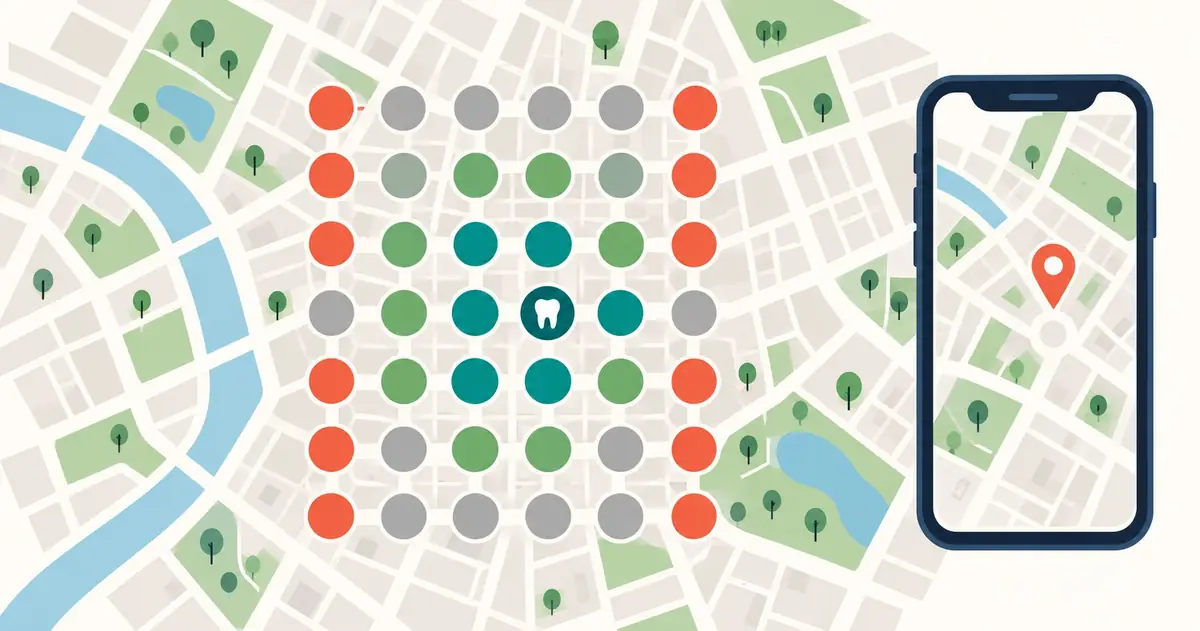
It is 9pm on a Sunday night. A person just three miles from your office has a cracked molar and searches "emergency dentist near me" on their phone. Google brings up a map with three dental offices. One of those three will get the call the next morning, and likely handle that family's cleanings for the next decade.
Dentists use local SEO to get into those top three spots. This matters not only near your office, where you likely already appear, but also in the neighborhoods where your patients reside. Many practices miss out on patients here without realizing, since most ranking reports only show results from a single location.
We develop ranking tools for local businesses, including dental offices, and we manage link campaigns for them. This guide is based on accurate measurements from map data taken across an entire area, as well as insights from 385 links built for 10 dental practices. You'll find sections on audits, profiles, websites, reviews, and the three types of links, followed by a step-by-step look at a 90-day campaign broken down by grid. All keyword figures use actual US search data collected in October 2026.
What is local SEO for dentists?
Local SEO for dentists involves helping a dental office appear on Google when someone in the area looks for a dentist, a specific procedure, or urgent dental care, appearing first in the map pack and then in the standard search listings underneath. This includes managing your Google Business Profile, creating a separate web page for every service you offer, collecting patient reviews, getting your practice listed on other directories (these are known as citations), and earning links from both dental-related and local websites.
The map pack is what counts most. If a person types "dentist near me," Google displays a map and three dental offices before listing any websites. If you show up in the map, you are likely to get the appointment. If you are ranked tenth further down the page, you will usually see almost no results. This is why this guide focuses more on the map section than any other part.
Why dental SEO is different from other local SEO
Your patients live nearby and remain with your practice for many years
Roofing businesses get clients based on where storms hit, but dental practices draw patients from just a few miles away. Each new dental patient is much more valuable than a one-time visit. A person coming in for a cleaning might bring their whole family and remain a patient for ten years. This shifts the calculation: dental offices can justify putting in significant effort to attract each new patient. The best approach is to focus on winning over the nearby neighborhoods, targeting them individually.
Trust is more important here than for nearly any other type of search
People look at dentist reviews much like they do restaurant reviews, but this time their health is involved. Most people will choose a practice with a 4.9 rating and 400 reviews over one rated 4.7 with 90 reviews, even if the second office appears a bit higher in the search results. Reviews affect both your ranking and whether people decide to click.
Treatments are separate searches
While "Dentist near me" is the main search, people also look separately for implants, Invisalign, whitening, pediatric dentistry, and emergency dental care, each with its own map listing. If your practice only appears for the general term, you are missing out on searches that bring in the highest ad spend. For example, "dental implants near me" has a Google Ads cost of $39.05 per click, since a single implant patient can be worth thousands.
Chains and directories fill up the map pack
Large dental groups, insurance directories, and appointment marketplaces all target the same search terms, and many have significant financial resources. What sets a single dental office apart is its true local presence. The following strategy is focused on demonstrating that local relevance to Google, one neighborhood at a time.
How Google decides which dentists show up
Google lists three main factors for local rankings: relevance, distance and prominence (its own help page explains them). Here’s how each one applies to your practice.
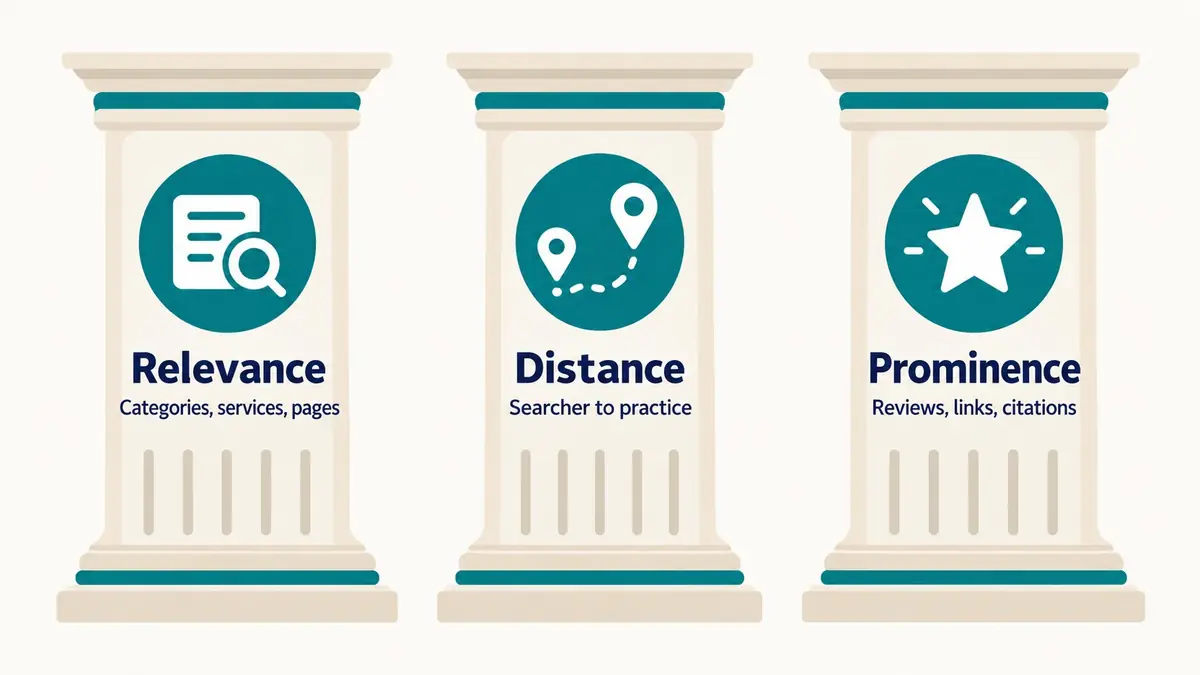
Relevance measures how well your practice aligns with what someone is searching for. The main category you choose, the services you include in your profile, the content on your website, and even the language in your reviews all contribute to this. For example, a practice that selects "Dentist" as its main category, adds "Emergency dental service" as a secondary category, and has a dedicated page for emergency appointments will be seen as more relevant to a search like "emergency dentist near me" than a practice that only has a general homepage.
Distance measures how close your business is to the searcher. Since your location cannot be altered, the other two factors become especially important for reaching people in more distant neighborhoods.
Prominence measures your reputation and recognition. Factors like the number and quality of reviews, the amount of mentions and links from other websites, and the accuracy of your business information across the internet all contribute. Prominence is what allows your practice to compete farther from your location, even when distance is not on your side.
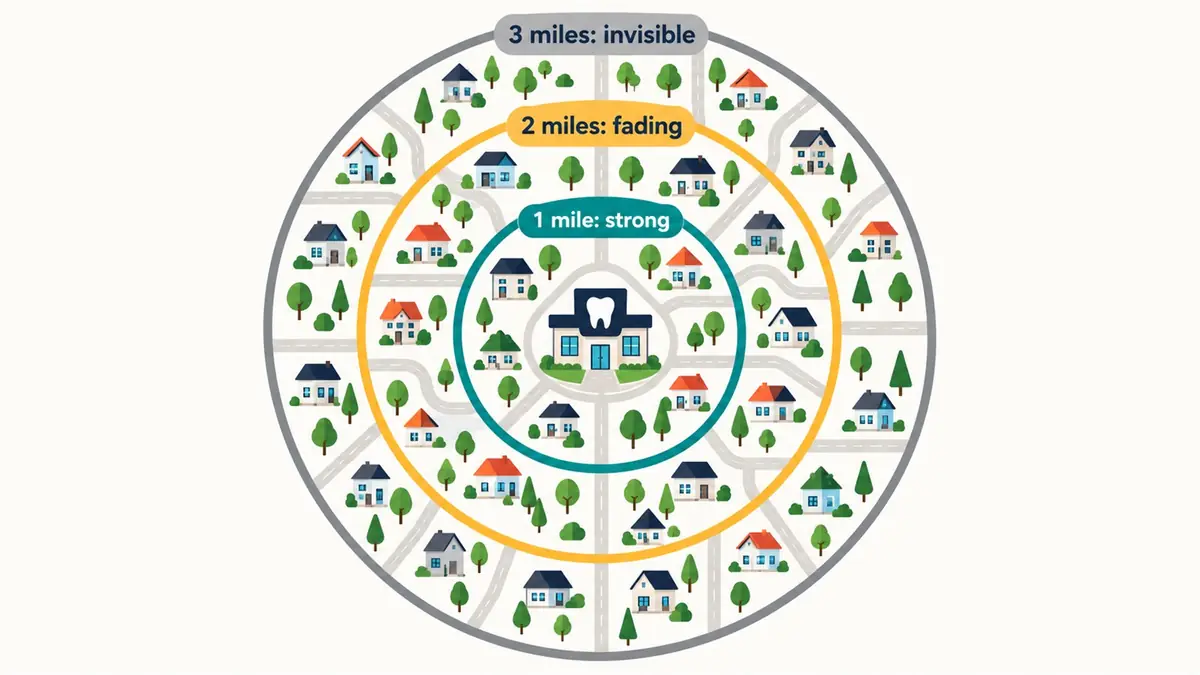
Combine these factors and you’ll notice the same trend at nearly every practice: your visibility is high near your office, but drops off the farther out you go. The only way to know exactly how this looks for your business is to measure it yourself.
Start with an audit, not a guess
Start by determining the current status of the practice. A thorough Google Business Profile audit reviews the profile, compares reviews with top competitors in the area, examines the website, checks citations, and most importantly, analyzes map rankings on a grid. Our 21-point audit checklist covers each step; the audit tool completes these checks in just a few minutes. For this guide, we audited a family practice located in a Texas suburb. This practice is not our client and its name is omitted; it shows what a well-managed practice looks like prior to any SEO improvements.
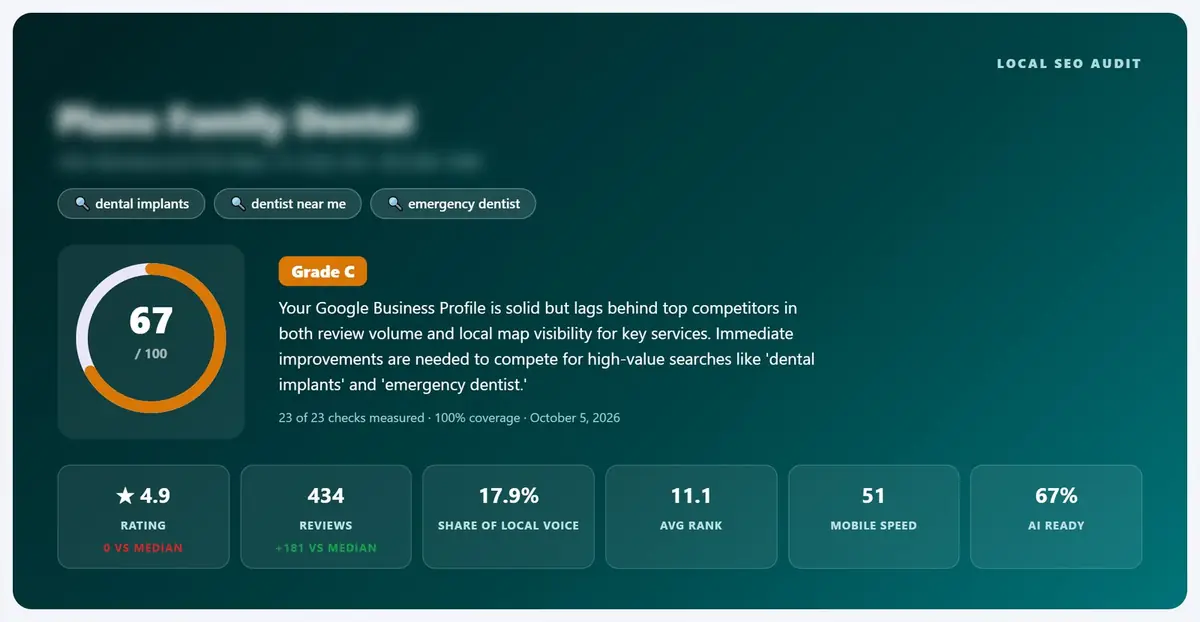
Take a moment to notice that cover. This practice has a 4.9 rating and 434 reviews, which is 181 more than the local median, yet its score is still only 67 out of 100. Its local voice share stands at 17.9%, so it controls under a fifth of the map for its keywords. Reviews are just one of three ranking factors. This practice has overlooked the other two.
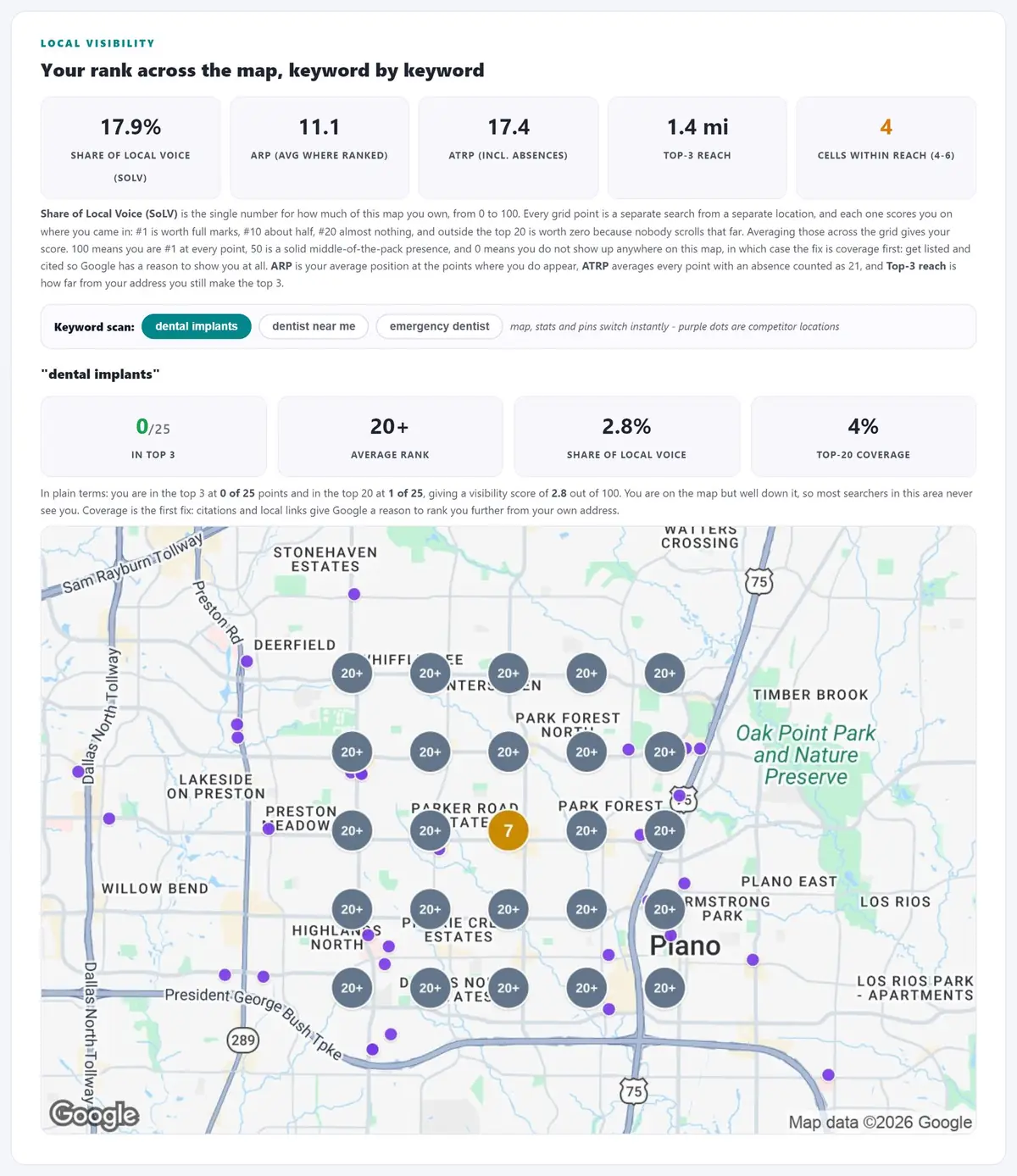
The work list is based on the sections below. For a dentist, three of these are especially important.
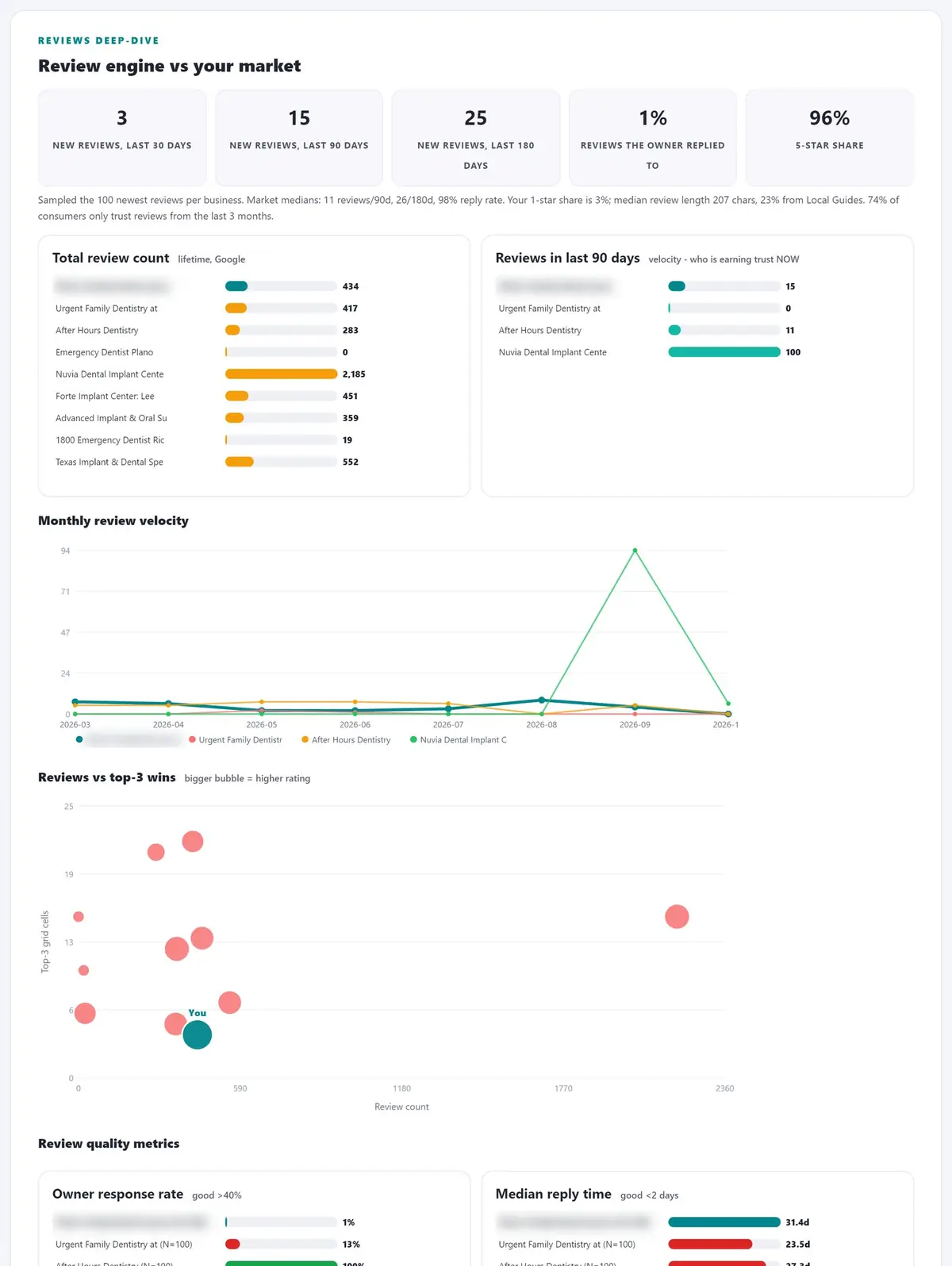
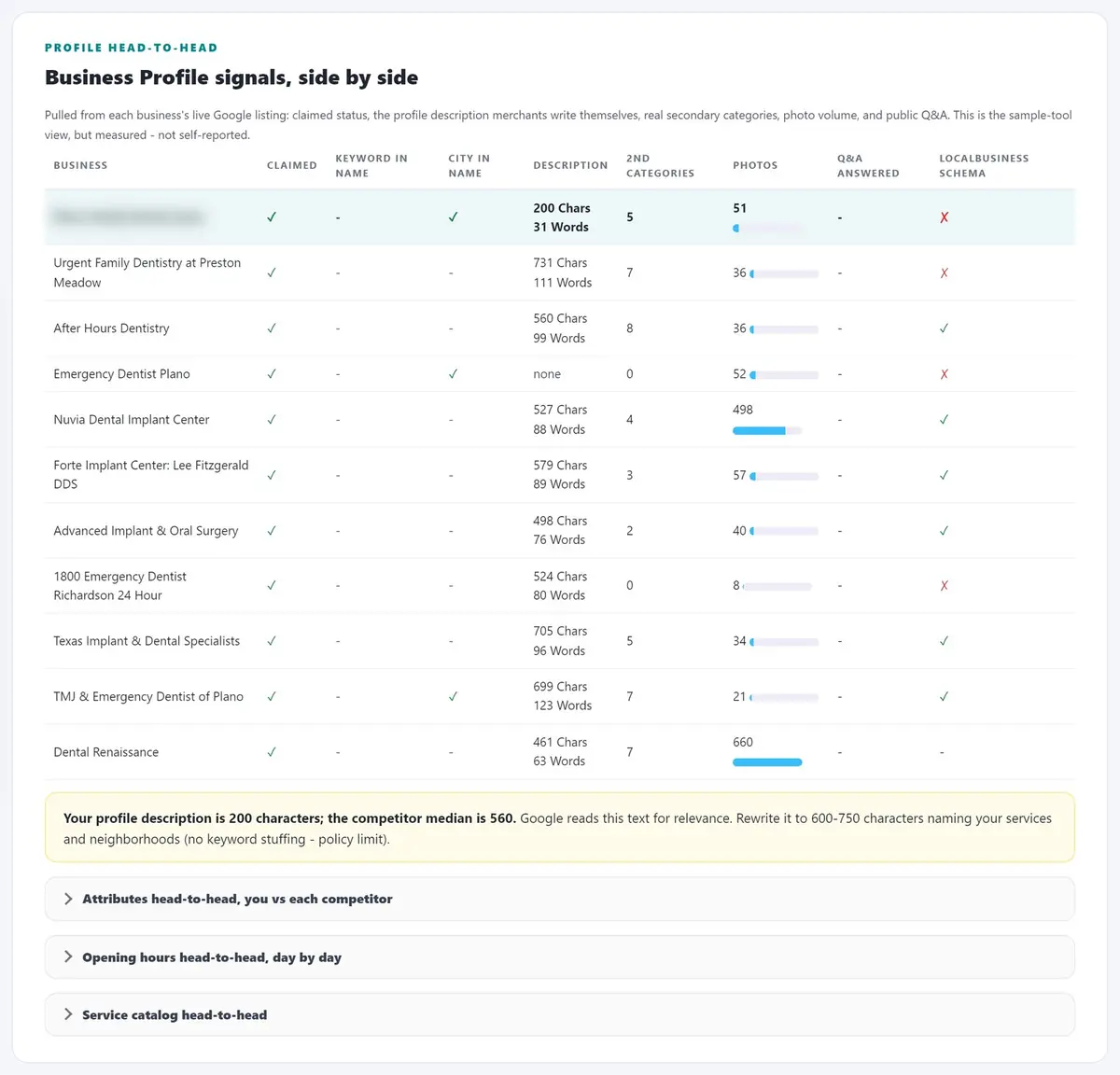
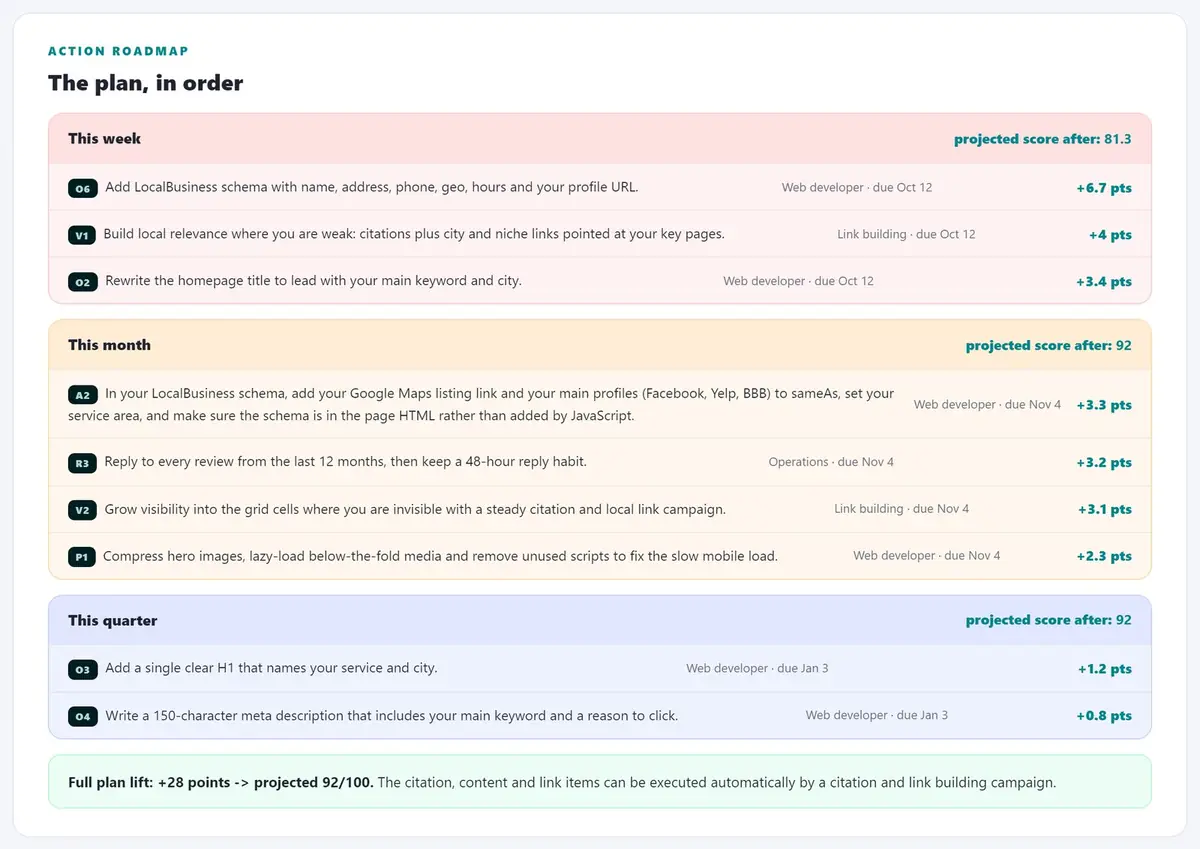
If you follow just one recommendation from this guide, make it this: order a grid-based audit of your profile and review the roadmap. The rest of this guide explains how to put it into practice.
Reading a dental rank grid
A rank grid measures your map ranking for a single keyword from multiple locations spread throughout your area. Rather than just giving you a single ranking like "you rank 4th," it displays a map highlighting spots where you are in the top 3, areas where you show up on page two, and locations where you are missing entirely.
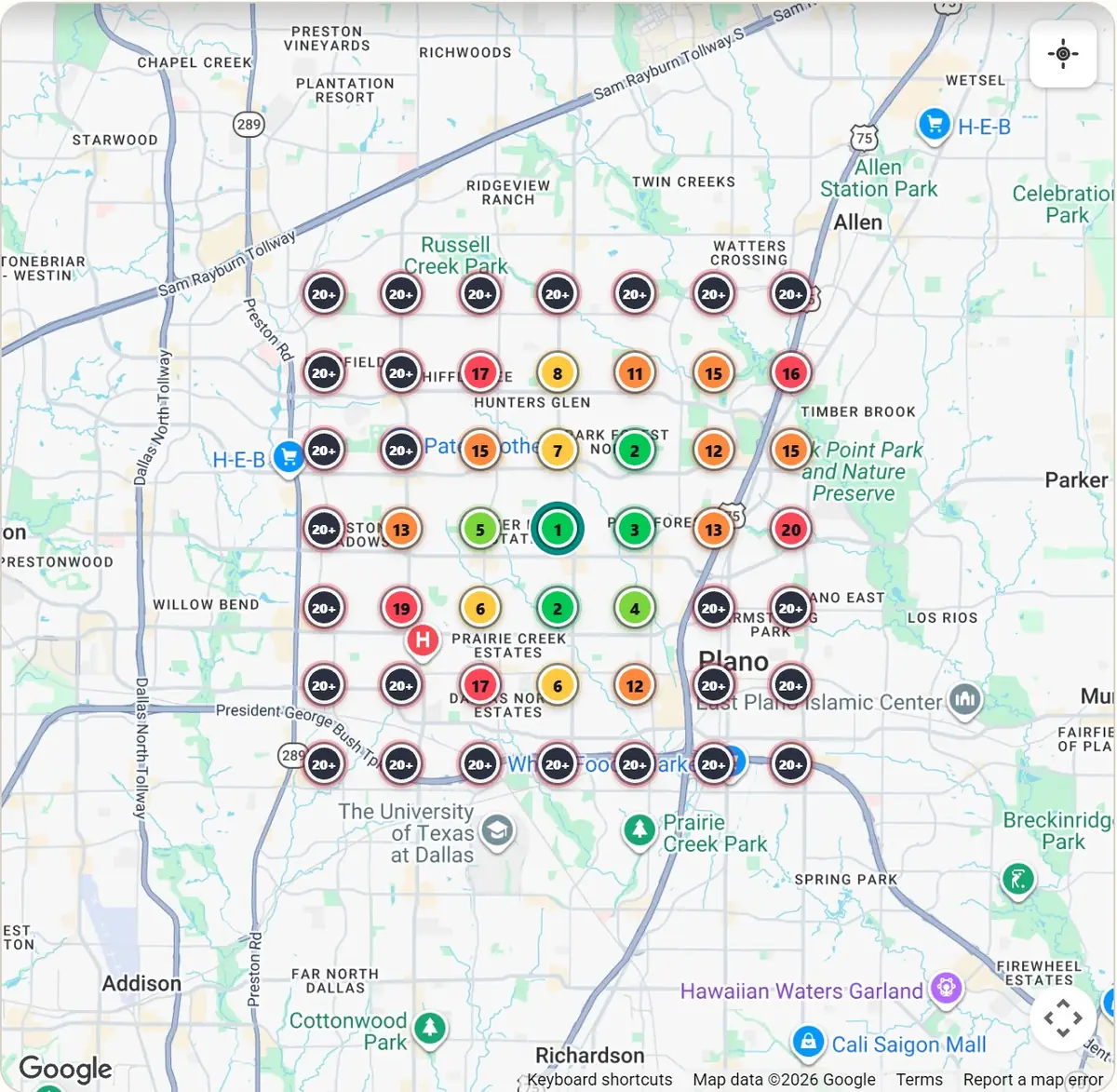
Here’s how to interpret this. The circled spot in the center represents the practice, which ranks 1st right at its own front entrance. At a distance of one mile, its ranking drops to between 2nd and 5th. Two miles out, it falls to between 13th and 20th place. The dark “20+” markers show areas where the practice isn’t listed in the top 20 at all. For families in those neighborhoods, the practice is essentially invisible.
The stats: top 3 in 4 out of 49 locations, not showing up at 26 out of 49. Visibility, meaning the percentage of the grid where the practice shows up at all, stands at 47%. This practice has 434 five-star reviews but is not seen in over half of its own city. The average rank (16 in the locations where it does appear) does not show this reality, which is why a single ranking figure does not help a dentist much. The metric that actually predicts phone calls is the percentage of locations in the top 3, since that is what appears in the map pack.
The pattern we see in almost every dental scan
Strong within about a mile of the office. Page two from one to two miles out. Invisible past that. The practices winning the whole city are the ones with the most reviews and the most links and mentions across the web, not necessarily the best dentists.
The searches that bring patients
Here are the dental keywords with the highest search volume in the US, along with their advertiser cost per click. A higher cost per click suggests these searches often result in new patients, so use this as a reference for which treatment pages to prioritize.
| Search | US searches / month | Difficulty | Cost per click |
|---|---|---|---|
| dentist near me | 1,830,000 | 49 | $13.92 |
| pediatric dentist near me | 201,000 | 26 | $10.93 |
| dental implants cost | 135,000 | 32 | $15.06 |
| dental implants near me | 110,000 | 90 | $39.05 |
| cosmetic dentist near me | 74,000 | 4 | $14.22 |
| dental crown cost | 74,000 | 0 | $8.29 |
| teeth whitening near me | 60,500 | 0 | $10.68 |
| teeth cleaning near me | 49,500 | 0 | $17.77 |
| family dentist near me | 49,500 | 41 | $12.05 |
| dentist open on saturday | 12,100 | 0 | $12.05 |
US search volume and cost per click, October 2026. Difficulty is for the organic results; the map pack is decided by the local factors above.
Two key points are clear. The phrase "Dentist near me" gets 1.8 million searches each month nationwide, and every search result includes a map. Also, searches for certain treatments like cosmetic dentistry, whitening, and cleanings have low difficulty. This means that a dental office with an actual page for each service can achieve rankings for those terms in just a few months.
Choose three to five keywords to monitor: "dentist near me," your emergency keyword, and your top two or three treatment searches. Check these on a grid each month. Ignore the rest.
Your Google Business Profile
Google ranks the profile first, so it takes priority over the website. Here is the order:
Categories
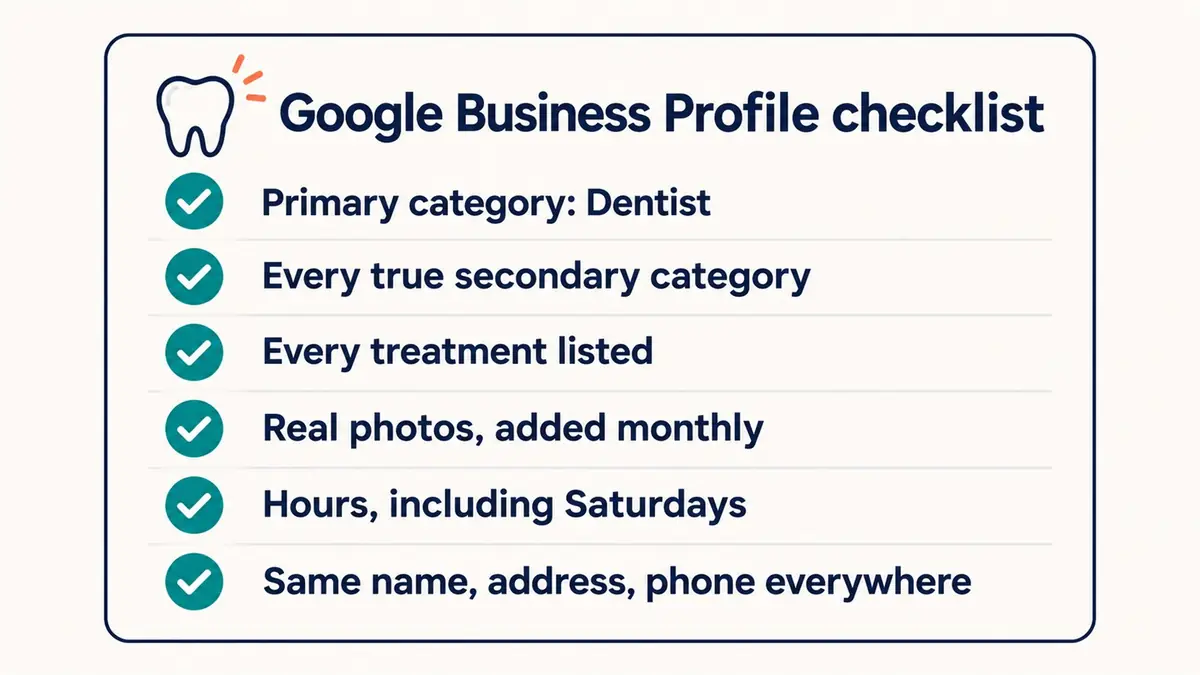
Start with "Dentist" as your main category. After that, include each secondary category that accurately fits your services: "Cosmetic dentist", "Emergency dental service", "Pediatric dentist", "Dental implants periodontist", and "Orthodontist" if you provide braces or aligners. Each category you add makes your practice appear in more relevant searches. Only select the options that truly match what you offer, since Google and patients both verify this information.
Services and treatments
Include each treatment as a separate service on your profile, adding a brief description and a price range whenever possible. Implants, crowns, whitening, Invisalign, cleanings, emergency appointments, and pediatric dentistry should all be listed. This forms the foundation of relevance.
Photos that look like your practice
Use real images: the entrance, reception area, all treatment rooms, your staff, and before-and-after results (with permission). Twenty quality photos are better than two hundred stock pictures. Upload a few new ones each month, since Google tracks updates.
Business hours, plus those patients look up
The phrase "Dentist open on Saturday" gets 12,100 searches each month. If your office is open on Saturdays, update your hours to reflect this and mention it clearly on your website. Always set your holiday hours ahead of time. If your profile lists you as open when you are actually closed, you risk getting one-star reviews.
Name, address, and phone must match everywhere
Decide the one way your practice name, address and phone number are written, and use that exact form on the profile, the website, and every listing. "Suite 100" versus "Ste 100", an old phone number on a directory, a previous practice name still floating around: each one weakens trust a little. The citation work below is mostly about fixing this.
Do not stuff the name
If you put "Best Dentist in Plano" in your profile name, you are violating Google's guidelines and risk having your profile suspended. That outcome is much more serious than dropping a few spots in search results. Your profile name should match the name displayed on your sign.
Treatment pages and a location page
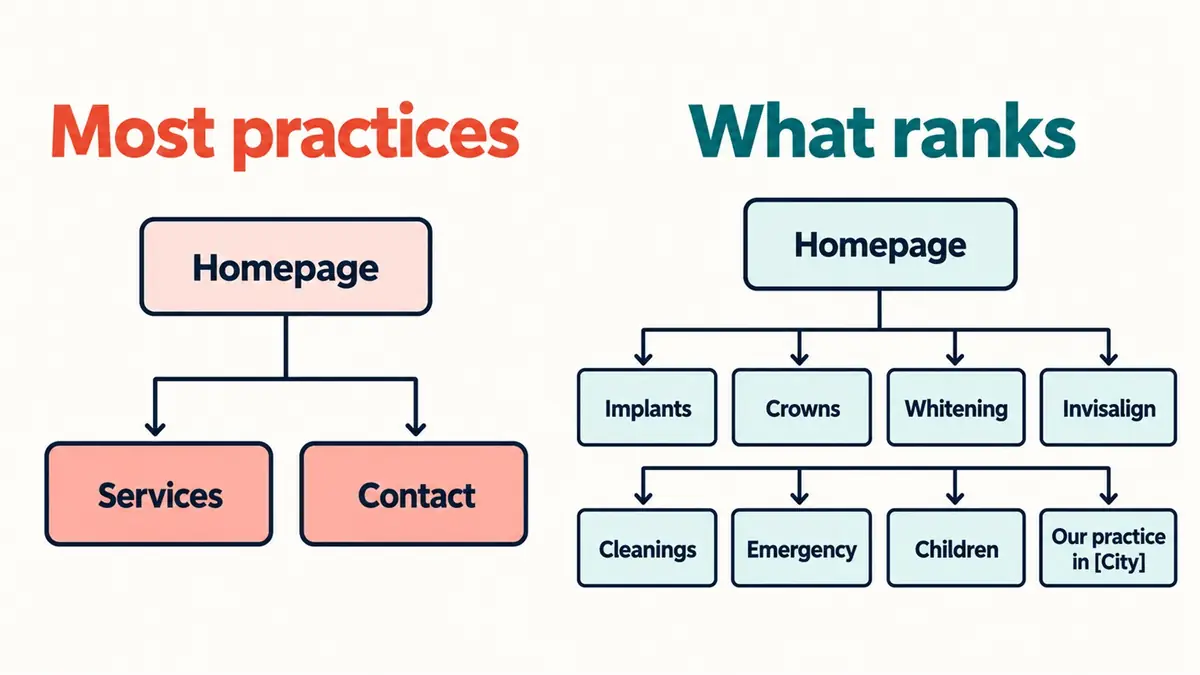
The typical practice website includes a homepage, a services page with short descriptions for each treatment, and a contact page. This setup does not give Google a reason to see you as relevant for "dental implants near me" since there is no dedicated page focused on implants.
One page per treatment
Implants, crowns, whitening, Invisalign, cleanings and check-ups, emergency dental care, and children's dentistry each have a dedicated page. Every page covers what the service includes, who it is best for, pricing details or how costs are determined, the expected time frame, and a few actual patient examples. The specific blog links listed below will direct users to these pages. Assign a unique title and description to each page; our meta tag generator creates both directly from the content.
Tell Google it is a dental practice
Structured data is a small code snippet placed on your website that defines your business using Google's terminology. Choose the Dentist schema (which falls under LocalBusiness), and include the practice name, address, and phone number exactly as shown on your profile, along with your opening hours, treatments listed under medicalSpecialty, and a sameAs link pointing to your Google profile. This code does not improve rankings by itself, but it clarifies what your site represents. If your website, profile, and directories do not match, audits will usually catch it quickly. You can follow the example provided in Google's local business markup guide.
One honest location page
Create a page focused on your practice within its city, highlighting the neighborhoods you work in, details about parking and public transit, and mentioning nearby schools and employers whose families visit your office. Include patient reviews that reference their locations. This page connects your business to the outer areas of your service map and is the right place for hyperlocal links. Avoid making separate pages for each suburb with just the name changed, as Google and users both see that as spam.
Address common questions people have before scheduling
"How much does a crown cost" is searched 74,000 times a month. "Dental implants cost", 135,000. A plain page that answers each one with real ranges earns links, earns trust, and often earns the spot in Google's AI answer. Write them in the words a patient uses, not a dentist.
Reviews that help you rank
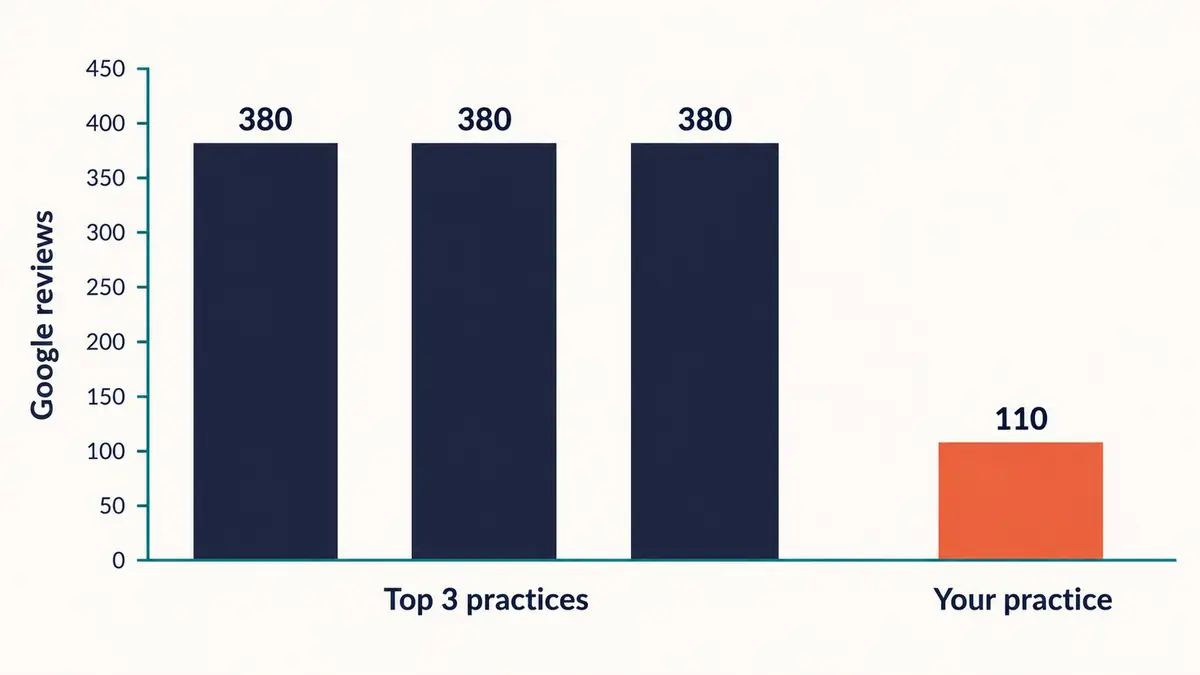
From our audits, we see that top-ranking practices in a city map pack often have a few hundred reviews. If your practice has 100 reviews, you will not catch up in just a month. That is why you need to begin asking for reviews immediately and keep doing it without pause. Here are three rules:
Ask every patient, the same day. A text with your review link, sent by the front desk before the patient reaches the car park, is the single highest-return thing in this guide. Expect one in five to leave a review if you ask consistently. Our review link generator makes the short link and a QR code for the front desk. Google says ratings and review count feed the prominence factor, and patients read them before they read anything else: in BrightLocal's consumer review survey, most people say reviews shape which local business they choose.
Respond to all reviews, even the positive ones. When you reply, Google sees that your profile is active, and future patients notice that you pay attention. Make your responses brief and personable.
Replying without breaking HIPAA
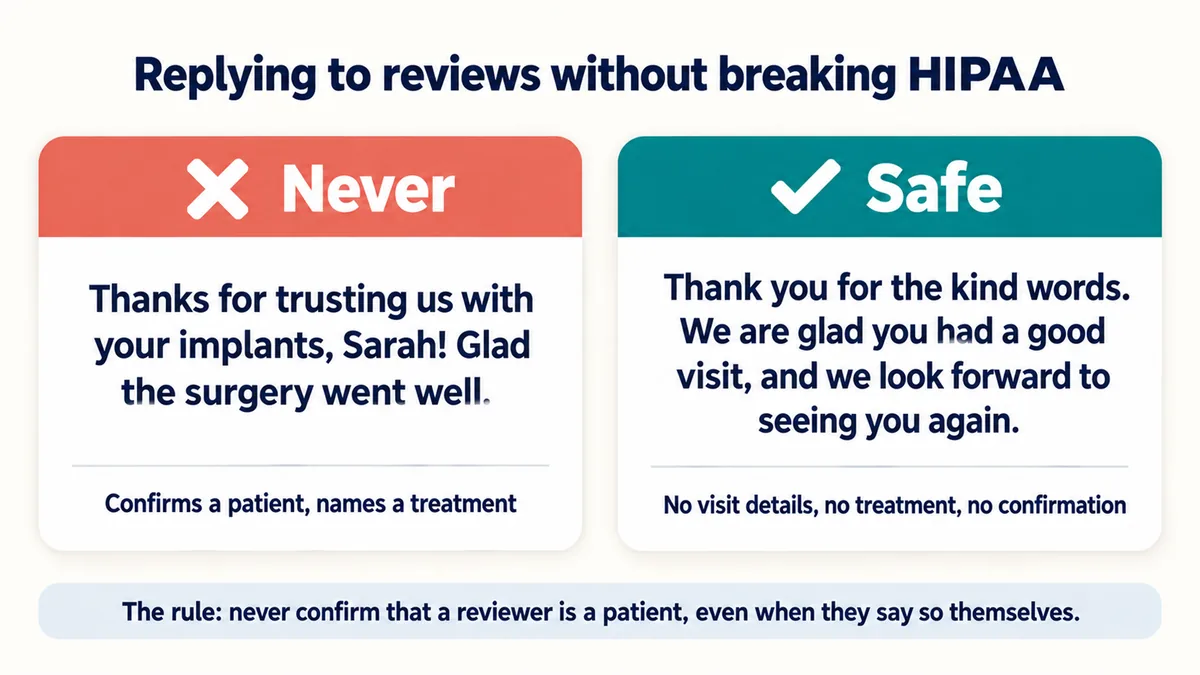
Dental SEO is unique because review replies are public, and HIPAA rules prevent you from confirming whether someone is a patient or discussing any treatment, even if the reviewer mentions it. Saying "Thanks for trusting us with your implants" breaks the rules. A safe response would be, "Thank you for the kind words, we are glad you had a good visit." For negative feedback, respond once, avoid arguments, do not reference any appointments, and provide a phone number to resolve the issue privately. Keep each reply brief and neutral, and have a single staff member handle them. Our review reply writer creates responses in this format. The rule is strict: never mention the visit.
Do not purchase or restrict access to reviews. Google will take down paid reviews and may suspend your profile. It is acceptable to request feedback from all patients or just satisfied ones. However, using a survey to screen out unhappy patients before asking for reviews is not allowed.
Citations, niche blogs and city blogs: the three kinds of links
Links create prominence, which is how you move beyond the initial ranking stage. We create three types of links, each serving its own purpose.
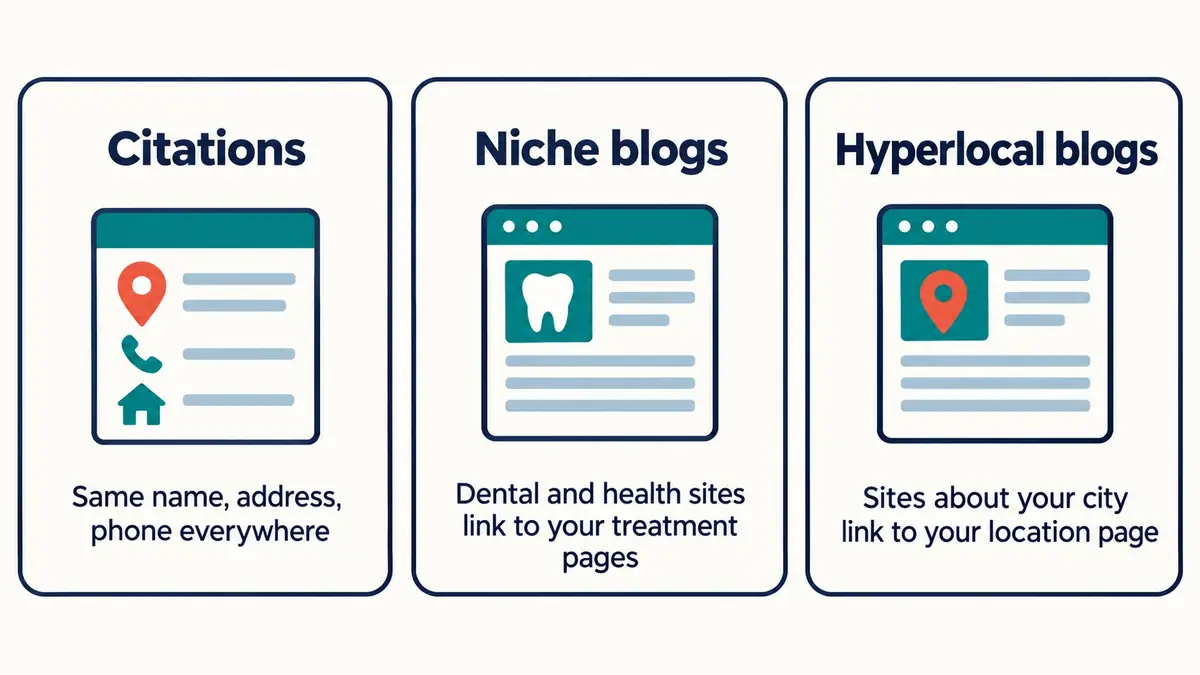
Citations refer to listings of your practice’s name, address, and phone number on directories, healthcare directories, map platforms, and local business listings. These do not provide significant "link power." Their main value is in repeatedly verifying that your practice is located at that address and phone number. Start by correcting any inaccurate listings, then work on creating additional ones.
Dentists have a longer list of directories to update than most other businesses, since patients look at both health-specific and general directories. The key ones include Google, Bing Places, and Apple Business Connect (which puts you on Apple Maps, the standard on all iPhones); Yelp and Facebook; health directories like Healthgrades, Zocdoc, Vitals, and WebMD; the ADA's Find-a-Dentist if you belong, plus your state dental association's listing; and the provider directory for every insurance company you work with, which is usually the most outdated. On each, look for your old address, phone number, and practice name, since these are the details that often cause confusion for both patients and Google.
Niche blog links are posts published on dental and health websites that include a link to a particular treatment page. For example, if there is an article discussing implant recovery and it links to your implants page, it sends a relevance signal. It shows that a dental website considers your implant page a valuable reference.
Hyperlocal (city) blog links refer to posts on websites focused on your city or neighborhood, each linking back to your location page. These links help connect your business to the neighborhoods where your grid currently displays "20+".
Distribute your links, use different phrases, and direct them to the most relevant pages. Adding thirty links each month, divided among the three categories, is a reasonable rate for a single practice. If you add three hundred in one week, it appears artificial rather than natural.
What our dental campaigns delivered
Here are the actual totals from dental offices that have used our platform for link campaigns, current as of October 2026. We do not list the practices by name since most are clients of our agency partners.
Dental practices
10
US and Australia, one location each
Links delivered
385
105 citations, 145 city blog links, 135 niche blog links
Still live and dofollow
100%
Every link checked was live and passing value
Found in Google
81%
Of citation and niche blog links, each one checked in Google on October 5, 2026
Two honest notes. First, we checked every link older than a month in Google itself rather than trusting our own records: 84% of the citations and 79% of the niche blog links were in the index. City blog links take much longer. They sit on smaller local sites that Google picks up slowly, and fewer than a quarter of them were indexed when we checked. If you buy links for a practice, ask to see this split, not one blended number. Second, the anchor text across those 385 links was 36% exact-match ("dentist in [city]"), 36% generic ("this practice", "their site"), 20% branded and 8% partial. That is roughly the natural mix we aim for.
Ranking results: coming in the next update
Those practices were scanned for links, not rankings, so we cannot yet show you a before and after map for a dental client. We have started baseline grid scans for every dental practice on the platform and will add the 30 and 60 day results to this post. The walkthrough below is illustrative until then, and says so.
Walkthrough: a dental practice's map from day 0 to day 90
Illustrative campaign. Day 0 is modelled on a real dental practice scan from August 2026; days 30 to 90 are a projection of how the campaign described above typically moves a grid, not measured client results.
All of that is the background. Here is how it works step by step: we use one practice in one city, build 30 links each month for three months, and scan the same 49 points every 30 days. Focus on the map’s outer areas instead of the center.
Visibility
71.4%
100%
Day 0 to day 90
Local voice
31.6%
62.4%
Day 0 to day 90
Top 3 points
1 of 49
7 of 49
Day 0 to day 90
Not ranking
14 points
0 points
Day 0 to day 90
"dentist near me": the same 49 points, every 30 days
IllustrativeDay 0
Week 1
Before any work
- Visibility
- 71.4%
- Local voice
- 31.6%
- Top 3 points
- 1
- Not ranking
- 14
Day 30
Week 5
After citations + niche blogs
- Visibility
- 75.5%
- Local voice
- 38.8%
- Top 3 points
- 3
- Not ranking
- 12
Day 60
Week 9
After niche + hyperlocal
- Visibility
- 93.9%
- Local voice
- 48%
- Top 3 points
- 5
- Not ranking
- 3
Day 90
Week 13
After citations + hyperlocal
- Visibility
- 100%
- Local voice
- 62.4%
- Top 3 points
- 7
- Not ranking
- 0
Before: where the practice was losing patients
The business
Illustrative- Business
- General dental practice, 3 dentists, one location
- Market
- One city. Every link and page targets that city only
- Starting reviews
- 112 reviews at 4.8
- Leaders in the area
- About 380 reviews on average
- Website
- Homepage and one services page, no page per treatment, no location page
- Tracked search
- "dentist near me", 7 by 7 grid, points about 1 mile apart
On paper this practice was doing fine. A 4.8 rating, a complete profile, ranking 3rd from its own front door. Ask the owner and they would say they were "on Google". Then the first grid came back: 14 of 49 points showed "20+". In more than a quarter of its own city, a family searching "dentist near me" would scroll through twenty practices without seeing this one. Only one point was in the top 3, right beside the office.
The day 0 scan gave three problems to fix, in this order:
1. The north side of the city performed poorly. It ranked 13th on average across 5 locations, and there was no content on the website or elsewhere online that connected the practice to those areas.
2. Near misses. Positions 4 through 7 are just outside the map pack, needing only a small boost to move up.
3. A review gap. The practices leading the area averaged about 380 reviews against this one's 112. Links alone would not close that, so review requests ran from day 1.
The 90-day action plan: citations, niche blogs, hyperlocal
The strategy called for 30 links per month, adding up to 90 links altogether, divided equally among the three types of links. Each month, we combined two types, so each month’s work built upon the previous month. Since the practice operates from a single location, all citations, hyperlocal articles, and the new location page target the same city.
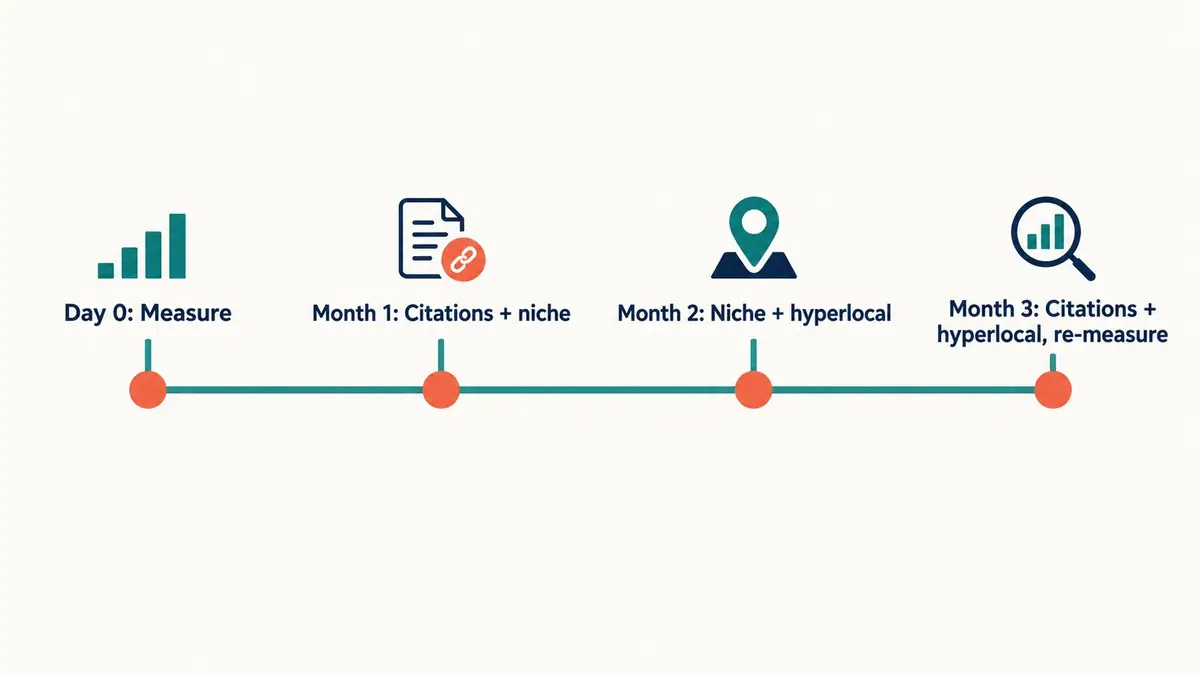
The 90-day action plan: 30 links a month, 90 in total
IllustrativeMonth 1 · Days 1 to 30
Citations + niche blogs
Make the listing consistent and prove dental relevance
- 3 old listings under the previous practice name fixed first
- 15 citations on local, health and map directories, all with the exact same name, address and phone
- 15 niche blog articles on dental and health sites
- Niche links to emergency dentist (5), dental implants (5) and the general dentistry page (5)
Links point at: Homepage and the three main service pages
What moved: 36 of 49 points improved. The rings within 2.5 miles moved most, and top 3 went from 2 points to 5.
Month 2 · Days 31 to 60
Niche blogs + hyperlocal
Keep building relevance and tie the business to its city
- 15 more niche articles, to teeth whitening (5), Invisalign (5) and emergency dentist (5)
- 15 hyperlocal articles on sites about the same city
- Hyperlocal topics weighted to the north side neighborhoods flagged on day 0
- Link wording mixed: practice name, name plus city, plain phrases
Links point at: Service pages and the new city page
What moved: 9 points that had never ranked started ranking. Visibility went from 77.6% to 95.9%.
Month 3 · Days 61 to 90
Citations + hyperlocal
Win the outer neighborhoods of the city
- 15 more citations on city directories, community sites and health associations
- 15 more hyperlocal articles on sites about the same city
- Topics covering the neighborhoods at the edge of the grid
- Each article links to the location page or the emergency dentist page
Links point at: Location page and emergency dentist page
What moved: The outer edge. Its average went from 14.0 to 9.8, and the last 2 grey points started ranking.
Month 1: 15 citations and 15 industry-specific blogs (days 1 to 30)
Cleanup came first. The practice was still listed under its old name in three directories, so we corrected those before adding anything new. After that, we published 15 citations on local, health, and map directories, each one showing the precise name, address, and phone number from the profile.
At the same time, 15 specialized blog posts were published on dental and health websites: 5 directed to the emergency dentist page, 5 to the implants page, and 5 to the general dentistry page. The site received dedicated treatment pages as well as a detailed location page. The front desk also began sending a review link by text to each patient on the day of their visit.
Day 30: the center improved. Local voice increased from 31.6% to 38.8%, and top 3 spots rose from 1 to 3. The area roughly a mile away saw the biggest gains. Steady citations and relevance from dental websites helped the practice become a stronger choice nearby. The outer edges remained unclear.
Month 2: 15 industry-specific blogs and 15 hyperlocal posts (days 31 to 60)
Month 2 kept the niche links going, now to whitening, Invisalign and emergency pages, and added the first 15 hyperlocal articles on sites about the city, weighted toward the north side neighborhoods the day 0 scan flagged. Every hyperlocal article linked to the location page.
Day 60: the edges began to fill out. Visibility increased from 75.5% up to 93.9%, and 11 out of the 14 grey points achieved rankings. The average rank stayed about the same, which is expected since new rankings usually appear around 15th or 18th place, pulling down the average even as visibility rises sharply. Many business owners get nervous and quit at this stage. You should not.
Month 3: 15 citations and 15 hyperlocal listings (days 61 to 90)
Over the past month, we built citations on city directories and community websites, and published 15 additional hyperlocal articles about neighborhoods on the outskirts of the grid, linking them to both the location page and the emergency page.
Results after 90 days
Results after 90 days, scan by scan
Illustrative| Metric | Day 0 | Day 30 | Day 60 | Day 90 |
|---|---|---|---|---|
| Local voice | 31.6% | 38.8% | 48% | 62.4% |
| Visibility | 71.4% | 75.5% | 93.9% | 100% |
| Points in the top 3 | 1 | 3 | 5 | 7 |
| Points in the top 10 | 14 | 18 | 25 | 36 |
| Points not in the top 20 | 14 | 12 | 3 | 0 |
| Average rank where it ranks | 9.4 | 8.6 | 8.1 | 7.3 |
| Outer edge average (20+ as 21) | 19.1 | 18.2 | 15.8 | 11.6 |
| Google reviews | 112 | 121 | 131 | 142 |
Scores at each scan
IllustrativeDay 90: visible across the whole city. Visibility 100%, no grey points left. Top 3 at 7 points instead of 1, local voice doubled from 31.6% to 62.4%, and the outer ring moved from an average of 19.1 (mostly not ranking) to 11.6. Reviews grew from 112 to 142 along the way, which is what let the links do their work.
Average rank by distance from the business (lower is better)
IllustrativeCenter
About 1.2 mi out
About 2.5 mi out
Outer edge, 3.7 mi+
What changed at each point, day 0 to day 90
Illustrative49 of 49
points ranked higher on day 90 than on day 0.
14 points went from not ranking at all to ranking, all of them on the outer ring of the city.
The center moved two places (3rd to 1st). Most of the gain is away from the practice, where new patients actually live.
Between day 30 and day 60, one point just south-east of the practice slipped from 7th to 8th. Small swings like that are normal from scan to scan.
Notice what did not occur: the practice did not reach the top spot in every area. After ninety days of effort, it moved from being unseen in much of the city to appearing on the map citywide and ranking in the pack for locations closest to its office. The following 90 days will focus on converting yellow points to green, which mostly involves gathering more reviews and building additional hyperlocal links.
We use this three-link structure for other service industries as well. The roofing guide shows how a roofing company's grid looks over the same 90-day period, which is helpful if you want to compare how the pattern shifts for businesses that go to their clients. The pest control guide covers a service-area business with a hidden address, where the suburbs matter even more.
Dental SEO and AI search
When people use ChatGPT or Google's AI mode to search for "who is a good dentist near me," both pull information from similar places: your profile, reviews, your website, and what is written about you elsewhere. During our audits, we ask these AI assistants the question directly and note which practices they mention. Practices that appear in their answers usually have detailed treatment pages, plenty of up-to-date reviews, and are referenced on other websites. So, the steps in this guide are also what help you show up in AI-generated results.
A useful step is to confirm your website is not preventing AI crawlers at the firewall. Many hosting and security tools now block these crawlers by default, and if they are blocked, your business will not show up in AI-generated answers.
Do it yourself or hire a dental SEO company
An office manager can handle the profile, photos, business hours, review requests, and treatment pages. The challenging tasks to manage on your own are tracking rankings throughout your area, creating citations at scale, and getting links from dental and local websites. These are usually the services practices hire out, which is what our monthly plans include. No matter what you decide, start by checking your map rankings using the free grid scan so you have a day 0 baseline for comparison.
Measure patients, not just rankings
A ranking grid shows your position, but three other steps help you see if that brings in patients. Add a UTM tracking tag to the website link on your profile so you can see in Google Analytics how many visitors arrive from the map. Use a tracking phone number on your profile that forwards to your front desk, so you can count map calls separately from calls coming from business cards. Connect your website to Google Search Console to view the searches where your site appears, including questions like "how much does a crown cost" that the map listing does not address. Compare all three data points to the grid at day 0 and again at day 90 to see if the campaign pays for itself, or not, and you will know for sure.
If you have more than one location
Every office should have a unique Google profile, a dedicated location page within the main website (never a separate website for each office), individual citations featuring its own phone number, and a separate grid scan. This is important because even offices just five miles apart show up on different maps. Reviews remain tied to each specific profile, so you need to request reviews at every front desk separately. Treatment pages are shared across locations, but location pages and hyperlocal backlinks are created for each office individually.
How to choose a dental SEO company
Ask these four questions before agreeing to anything. How will you track my rankings? If they only give you a single number from one spot, that is a red flag. What do you actually create each month? Find out about pages, citations, links, and the sources of those links. How do you keep my business info the same everywhere? They should be able to provide your citation listings. Do you promise rankings? No one has control over Google. Promises like that often mean you are being locked into a long contract.
Dental SEO mistakes we see most often
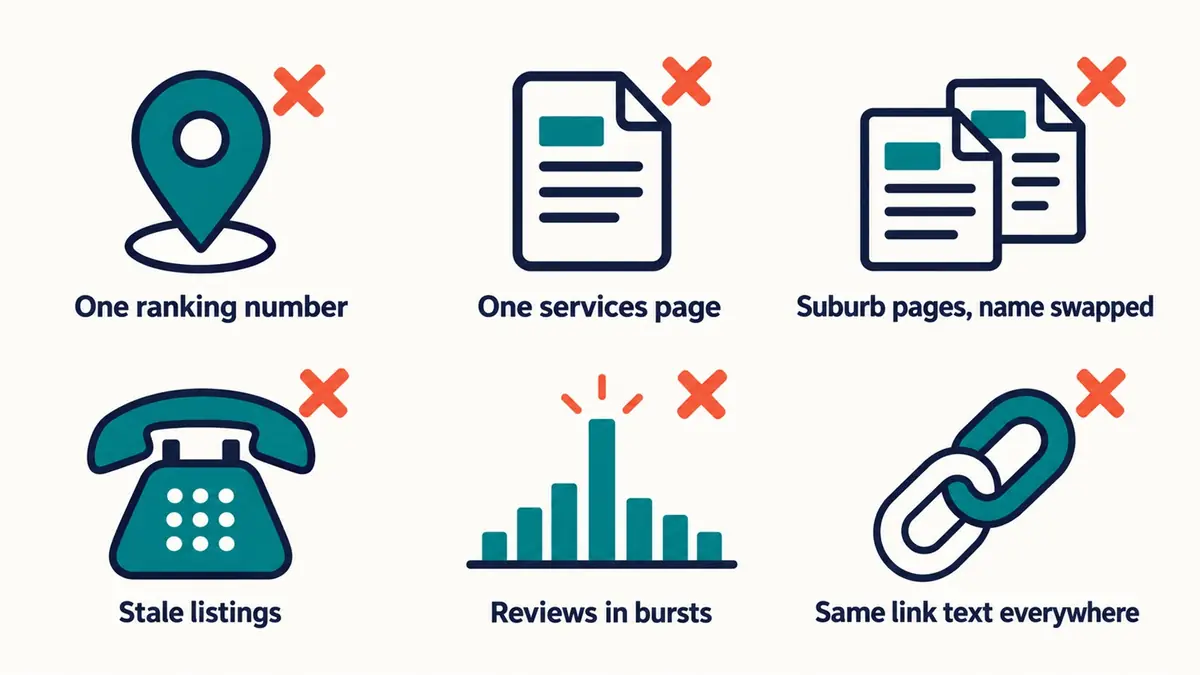
Using a single ranking to measure success. When someone at the front desk says, "We rank 2nd for dentist near me," that does not reflect how you appear in neighborhoods just three miles out. Check your performance across the whole grid.
A single services page covers all your offerings. Google will not rank your site for implants unless you have a dedicated page about implants.
One page for each suburb, just changing the name. A single genuine location page will outperform twenty low-quality ones, and Google will penalise those twenty.
Stale listings. An outdated business name or an incorrect phone number in a directory quietly undermines all your other efforts. Correct these issues before you start any new work.
Requesting reviews in large groups. If you get fifty reviews in one week after not receiving any for a year, it appears suspicious. Gathering a consistent handful each week makes your business seem active.
Links that all use identical wording. When each link says "dentist in [city]", it appears artificial. Use a mix of your practice name and natural-sounding terms.
A 90-day dental SEO plan
Add this to your notes. Everything listed above is addressed on each line.
Week 1: measure
Run a profile audit and a rank grid for "dentist near me" and your top treatment
Note the neighborhoods showing 20+ and which practices cover the most ground
Count the review gap between you and the leaders
Weeks 2 to 4: foundation
Primary category Dentist, every true secondary category added, every treatment listed
Real photos uploaded, hours checked including Saturdays and holidays
Name, address and phone fixed on every directory, citations built
Review link texted to every patient the same day
Weeks 5 to 8: pages and niche links
One page per treatment, starting with the ones advertisers pay most for
One honest location page for your city
Niche blog links to treatment pages, varied wording, spread over the month
Weeks 9 to 12: city links and re-measure
Hyperlocal links pointed at the location page, weighted to your weak neighborhoods
One plain page answering a cost question patients ask
Re-run the same grid and compare visibility and top 3 points, not just average rank
See your practice's own grid
Scan "dentist near me" across your city and see exactly which neighborhoods you are missing. Then audit the profile and get the roadmap.
Questions people ask
What is local SEO for dentists?
Local SEO for dentists means helping your dental office appear in Google’s map pack when people in your area look for a dentist. The map pack is the group of three dental practices shown with a map above the regular search results. This process involves optimizing your Google Business Profile, managing reviews, creating a separate webpage for each service you offer, getting your practice listed on other directories (citations), and earning links from related websites. Most new patients find a dentist through the map pack, since searches such as "dentist near me" show the map section at the top.
How much does SEO cost for a dental practice?
Most dental SEO retainers cost anywhere from a few hundred to several thousand dollars per month. What matters more than the price is exactly what is included: which pages are created, the number of citations and links, and the way rankings are tracked. Many dental offices divide the tasks. The staff manages the profile, uploads photos, and asks for reviews, while only paying for services that require specialized tools or access to a link network. We charge by the link and by the scan, so you know exactly what you are getting each month.
How long does dental SEO take to work?
Updating your profile and consistently getting new reviews can improve your map rankings in just a few weeks. When it comes to links and new treatment pages, you will usually see results across your area in two to three months, since Google needs time to discover and index those links. You can look for the first noticeable changes after about 30 days, with more significant shifts happening by around day 90.
Can a dentist do SEO themselves?
Yes, much of it can be handled yourself. An office manager can select the most accurate categories, list all treatments on your profile, add genuine photos of your practice, request reviews from satisfied patients, and create a separate page for each service. The more challenging tasks are tracking rankings throughout your region, creating citations in large numbers, and obtaining links from dental and local websites.
Do Google reviews help a dentist rank?
Yes. Google uses review quantity, star ratings, and how fresh the reviews are as part of its prominence factors. Reviews that mention particular services or treatments, like "my implant" or "Invisalign," also boost relevance. The top practices in most city map packs typically have a few hundred reviews. If your practice has 100 reviews, you will not catch up to them in a single month. That is why it is important to begin asking for reviews right away and to keep requesting them consistently.
Why does my dental practice show up on Google in some neighborhoods but not others?
Google considers the searcher’s location when ranking your business. Proximity is a key local ranking factor, so your practice typically appears more prominently near its address and less so as the distance increases. To improve rankings farther from your location, you need signals that connect your practice to those neighborhoods, such as a dedicated location page, reviews from patients in those areas, and links from websites focused on that part of town.
What is the best way to market a new dental practice?
Most practices that keep their schedules full rely on several sources: local SEO to appear in the Google map pack, paid search or Local Services Ads to get quick calls, and referrals or insurance directories. SEO takes the longest to gain traction but brings in patients at the lowest cost over time, since you do not pay per click. Ads can help bring in new patients while your SEO efforts are ramping up.
How do I choose a dental SEO company?
Request to view ranking results shown on a grid covering your area, rather than just a single ranking from one location. Find out what specific work is done each month and the sources of any links they build. Ask how they ensure your practice’s name, address, and phone number stay the same across all listings. Be cautious with promises of guaranteed rankings, since no one can control Google, and these guarantees often come with contracts that are tough to exit.